Fin-X Weekly Update 26th October 2026

Equity markets weakened last week as persistent inflation risks and a deepening reassessment of AI spending outweighed strong earnings. Bond yields eased while credit spreads widened, and energy prices rose while gold fell sharply.
China's growth accelerated on exports and high-tech manufacturing, though domestic demand remained soft.
This week brings Australian inflation data, US and European GDP figures, several important central bank decisions and a continued heavy run of corporate results.
Economic data was relatively scarce last week, but markets were volatile, dominated by two intersecting themes: persistent inflation risks and a deepening reassessment of the sustainability of AI capital expenditure, which together weighed on investor sentiment despite strong earnings.

Brent crude topped US$116–117 per barrel after fresh attacks in Saudi Arabia, sustaining inflation concerns ahead of this week's Federal Reserve meeting.
President Trump hinted that US forces in the Middle East would resume strikes on Iran after the 3rd November midterm elections, and dispatched a third aircraft carrier strike group and 10,000 additional sailors and Marines towards the Persian Gulf. He also signed an executive order waiving some newly imposed sanctions and tariffs on Russia, potentially easing restrictions on Russian energy exports. The move initially weighed on oil prices before Middle East risk reasserted itself.
Nevertheless, the 10-year US Treasury yield fell -8 bps to 4.99%, helped in part by a large bout of bond buying by CTAs (systematic trend-following funds) on Thursday. Among interest-rate-sensitive sectors, global infrastructure added +1.8%, extending its recovery of recent weeks, while property continued to struggle. The US dollar was broadly steady, while gold fell more than -5%.

In France, Yellow Vest protesters called for a second round of demonstrations in response to prospective government spending cuts. Added political uncertainty weighed on the euro, despite expectations of a December rate rise.
UK CPI rose to +3.5% yoy in September, an 11-month high, keeping the Bank of England on track for a potential rate hike next week.
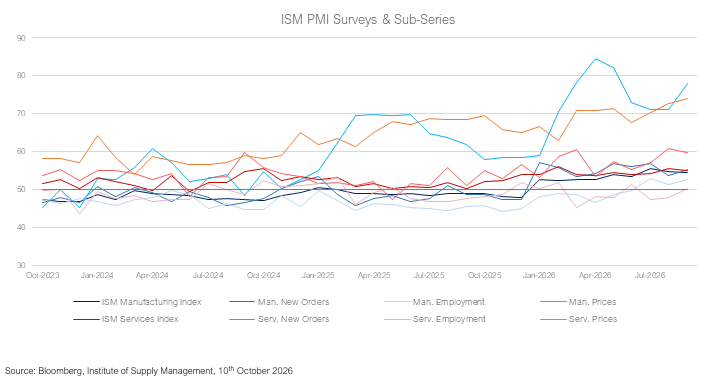
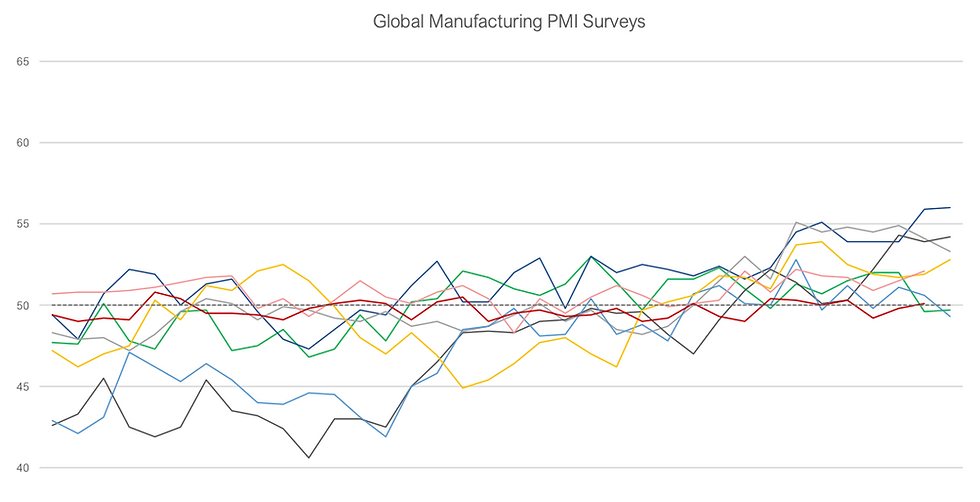
Price pressures were a consistent feature of S&P Global's flash PMIs for October, amid diverging growth prospects across economies. US demand remained strong, and the UK improved, while Europe lost momentum and Australia slipped into contraction, driven by services.
S&P Global reported that Australian input-cost inflation reached its fastest pace since May and that selling-price inflation accelerated. This week's consumer price figures are expected to show headline inflation accelerating from +4.0% yoy in August to +4.2% yoy in September, with trimmed mean inflation holding steady at +3.6% yoy.
RBA Deputy Governor Andrew Hauser said on Wednesday that Australia's inflation outlook is "materially worse" than the August forecast, citing higher AI and technology prices, persistent domestic pressures and signs that inflation expectations may be becoming unanchored. Goldman Sachs subsequently called for a 25 bp hike at the November meeting, which is now 64% priced in.
The Australian dollar posted its biggest weekly gain since April, rising +1.3% against the US dollar. RBA Assistant Governor Christopher Kent said the Australian dollar may be marginally above the long-run equilibrium estimate for the real trade-weighted index.
China's GDP grew +4.5% yoy in Q3, up from +4.3% in Q2, bringing growth over the first three quarters to +4.6%, broadly in line with the government's 4.5%–5% annual target. Strong high-tech manufacturing and export growth, particularly in AI-related goods, drove the acceleration. Domestic demand remained soft: retail sales rose just +1.1% yoy in September, while property investment contracted -20% yoy through September.
People's Bank of China Governor Pan Gongsheng signalled that the overnight reverse repurchase rate will replace the seven-day rate as the main policy benchmark, aligning China's framework more closely with global peers.
After a busy reporting week, S&P 500 earnings are up +38.0% yoy with 122 members so far having reported, according to Bloomberg. US large-cap indices nevertheless fell over the week, led by technology and AI-linked names, after results from Meta and Tesla failed to dispel concerns about the scale and funding of AI capex. The Nasdaq fell more than -2.5% on Thursday, with the Philadelphia Semiconductor Index down as much as -6.7% on the day.
Meta's disclosure of US$825 billion in future spending commitments and a raised 2026 capex range of US$135–145 billion triggered a record surge in its five-year credit default swap (CDS) spreads. The company generated free cash flow of - US$2.12 billion in Q3, its first cash burn since its IPO year.
Tesla cut its 2026 capex target to approximately US$20 billion from more than US$25 billion, after Q3 capex of US$4.73 billion came in well below the analyst consensus of US$7.95 billion. The reduction raised questions about the pace of the broader AI infrastructure build-out.
The dominant story in the Australian market was NEXTDC. The data centre operator cut its FY27 underlying EBITDA guidance by approximately one-third, to A$245–265 million from A$385–410 million, after community opposition delayed power supply to its M3 Melbourne facility. The shares fell approximately -42% on Wednesday, wiping around A$2.9 billion from its market capitalisation.
Global credit spreads rose to a 17-month high on Friday, according to Bloomberg, and more than US$5 billion of US and European bond and loan sales were postponed during the week, the largest spate of delays this year. Even so, the market expects Anthropic to proceed with its IPO plans. Elon Musk also confirmed during SpaceX's earnings webcast that SpaceX and Tesla had formed special committees of independent directors to explore a potential merger. A combination would rank as the largest corporate merger ever attempted, with the combined entity potentially valued at approximately US$3.5 trillion.
This week, alongside Wednesday's Australian CPI figures, the Federal Reserve is expected to keep rates on hold ahead of next week's midterm elections, with holds also likely from the ECB and the Bank of Japan.
The US and several European countries will publish Q3 GDP numbers, and another 179 S&P 500 companies are due to report quarterly results, including Alphabet, Microsoft, Amazon, ExxonMobil, Eli Lilly and ResMed.


Disclaimer
The contents of this communication are prepared by Fin-X Capital Group Pty Ltd (A.C.N. 627 650 293; AFSL 520526 trading as Fin-X Capital). The information contained in this communication is general in nature and does not take into consideration any investors personal objectives, goals, needs and financial situation. You should not rely on the information contained in this document to make any investment decisions without first consulting an investment professional such as your financial adviser. Any unauthorised use of this document is prohibited. This document (including any attachments) is intended only for the addressee, it may contain information of a privileged and confidential nature. If you are not the addressee of this communication, you must not copy, reproduce, disseminate or use this email and its contents. If this communication has been received in error by you, please inform us immediately and securely delete. Sharing, transmitting, copying, disseminating all or part of the contents of this document may result in a breach of the Federal Privacy Legislation and or copyright and trademark infringement of Fin-X Capital Group Pty Ltd and its related entities.