Fin-X Weekly Update 19th October 2026
Global equities slipped last week as stronger US inflation data and rising energy prices outweighed easing bond yields, while a global sell-off in AI-related stocks deepened.
The IMF nudged its global growth forecast higher but warned that risks remain skewed to the downside.
US price pressures continued to build, though markets read the Fed Chair's remarks as consistent with steady rates this month.
The Australian dollar weakened on signs of a softening labour market.
This week brings a heavy run of US corporate earnings and the latest flash PMI surveys from S&P Global.

Global equities slipped last week on stronger US inflation data and a renewed upswing in energy prices, despite bond yields easing as buyers returned. Infrastructure and property recaptured some of the losses of the past three months.
Coinciding with the semi-annual meetings in Thailand, the IMF's latest World Economic Outlook stated: "Global economic activity has proven resilient once again. The technology upturn, buffers, and adaptations have helped mitigate the damage from geopolitics-driven disruptions. Global growth is projected to slow to 3.1 percent in 2026 and rebound to 3.4 percent in 2027. Global headline inflation is projected to rise notably to 4.7 percent in 2026 before easing to 4.1 percent in 2027. Energy-importing economies outside the technology value chain face the most difficult outlook."
The +3.1% growth forecast for this year is +0.1 percentage points above the July estimate, but still down from +3.5% in 2025. Next year's forecast is unchanged.
The IMF went on to warn that "the margins of adjustment that helped resilience are not limitless, and risks are skewed to the downside. Further escalation in conflicts, a reassessment of expectations surrounding artificial intelligence (AI), renewed trade tensions, and fiscal vulnerabilities could weaken growth. On the upside, stronger momentum in AI investment and productivity gains from AI or a sustained easing of geopolitical and trade tensions could strengthen growth."
AI-related stocks came under further pressure. Chipmakers fell for eight consecutive sessions, their longest losing streak since 2008, as investors questioned whether the AI infrastructure build-out can generate adequate returns. The Philadelphia Semiconductor Index sank more than -12% on the week, while short sellers reportedly amassed an estimated $32 billion in gross paper gains, according to Bloomberg.

The S&P 500 posted its worst weekly loss since June and the Nasdaq 100 its worst since April 2025. CoreWeave's collapse accelerated the rout on Friday, after its bonds had recently come under pressure.
The AI sell-off was global. South Korea's Kospi tumbled as much as -8% on Thursday as SK Hynix and Samsung each fell by roughly -20% in US dollar terms. TSMC dropped -9% even after delivering another record quarter, with net profit surging +69% yoy and revenue rising +51%.

Decent US bank earnings also failed to lift sentiment, with the KBW Bank Index down roughly -13% from its August record on flattening yield curves and widening credit spreads in the riskier parts of the market.
Microsoft nevertheless hit its first record high in approximately a year on Tuesday, following a +54% rally from its June low. Emerging market stocks and currencies staged a partial recovery on Friday, as Fed Chair Warsh's remarks at the IMF meeting were read as consistent with a hold at the Fed's meeting at the end of the month.
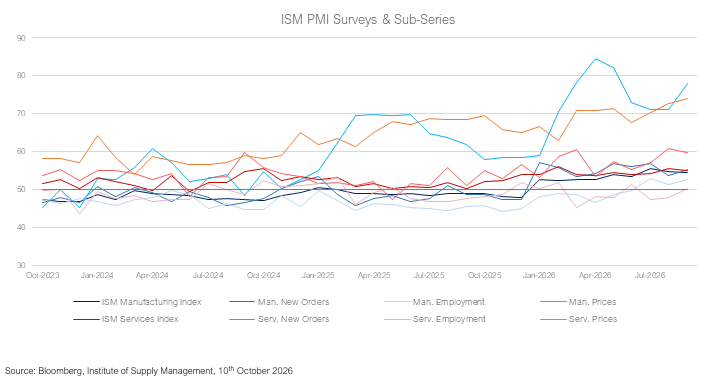
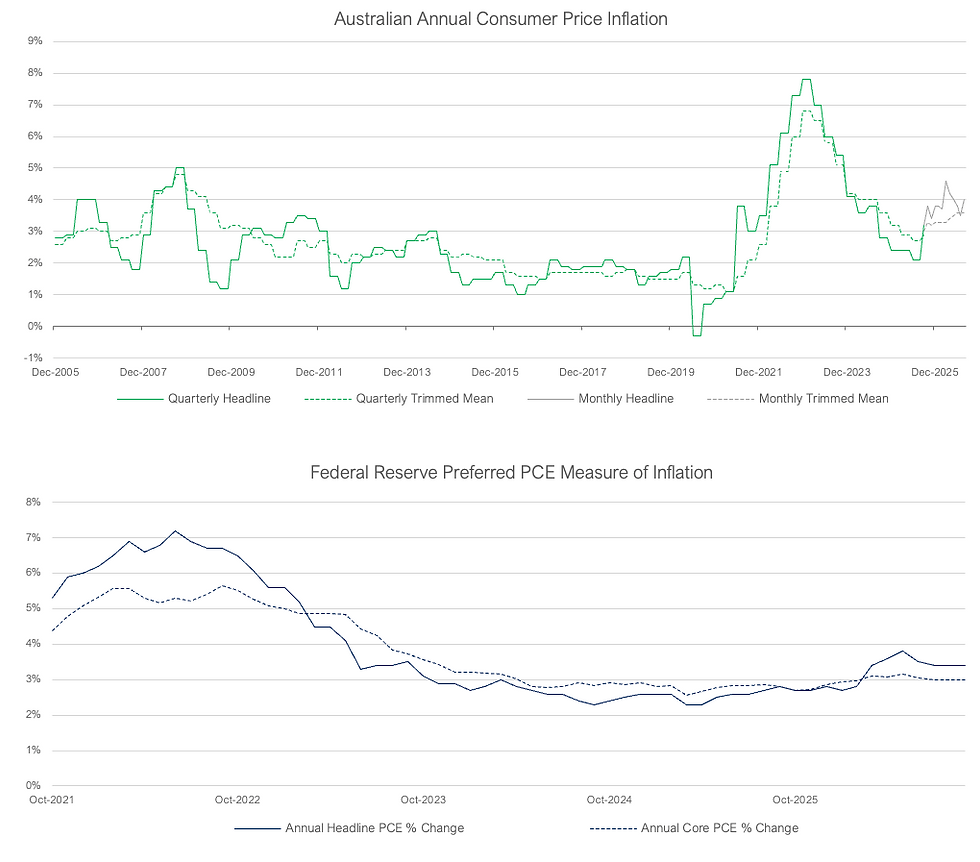
The Fed Chair did not specifically address last week's energy-driven upside surprises in US September CPI (+3.7% yoy) and PPI (+6.3% yoy), and markets interpreted his silence as leaning towards a move in December. The Fed's Beige Book nevertheless echoed the recent ISM surveys in indicating intensifying price pressures. With Chinese PPI accelerating to +5.0%, inflationary pressure is increasingly likely to be imported through manufactured goods.
Energy prices also pushed US retail sales to the top end of economists' estimates in September, at +0.8%. The control group, which feeds directly into GDP calculations and strips out autos, gas, building materials and food services, came in below expectations at just +0.1%, suggesting underlying consumer momentum was softer than the headline figure implied.

The upside surprise in industrial production of +0.7%, nearly double the consensus estimate of +0.4%, was seen as a better signal. It was driven by solid factory output around the AI infrastructure build, but also owed much to significantly stronger utilities output on higher energy costs.
The euro strengthened against the US dollar for the first time in more than five weeks, as US rate expectations were pared back and ECB speakers continued to expect further rate rises.
The British pound also strengthened after real GDP grew +0.1% in August, following -0.4% in June and July, beating economist expectations for a small contraction.
In contrast, the Australian dollar weakened against a broad basket of currencies after September employment figures confirmed an ongoing softening in the labour market. Headline employment declined by -39,300, reversing August's +29,300 gain and sharply underperforming market expectations for a +20,000 increase. The weakness was concentrated in part-time roles, which fell by -73,700, while full-time employment rose by +34,400.
The unemployment rate held at 4.7%, marginally above the RBA's August forecasts. The participation rate edged down to 66.8% from 67.0%, signalling a small withdrawal of labour supply that likely cushioned the unemployment rate from rising further. The market is no longer quite fully pricing in another rate increase this cycle.
On Thursday, Elon Musk unveiled the new Tesla Roadster, featuring cold-gas rocket thrusters, at an event the Wall Street Journal dubbed "pure spectacle" and light on details.
Tesla will report quarterly earnings this week, along with 75 other S&P 500 companies, including Alphabet, Meta, IBM, Netflix, Exxon Mobil and Chevron. Friday's S&P Global Flash PMIs will be the most important macroeconomic data.


Source: S&P Dow Jones, MSCI, Korea Exchange, BLS, ABS, 17th October 2026


Disclaimer
The contents of this communication are prepared by Fin-X Capital Group Pty Ltd (A.C.N. 627 650 293; AFSL 520526 trading as Fin-X Capital). The information contained in this communication is general in nature and does not take into consideration any investors personal objectives, goals, needs and financial situation. You should not rely on the information contained in this document to make any investment decisions without first consulting an investment professional such as your financial adviser. Any unauthorised use of this document is prohibited. This document (including any attachments) is intended only for the addressee, it may contain information of a privileged and confidential nature. If you are not the addressee of this communication, you must not copy, reproduce, disseminate or use this email and its contents. If this communication has been received in error by you, please inform us immediately and securely delete. Sharing, transmitting, copying, disseminating all or part of the contents of this document may result in a breach of the Federal Privacy Legislation and or copyright and trademark infringement of Fin-X Capital Group Pty Ltd and its related entities.