Fin-X Weekly Update 5th October 2026

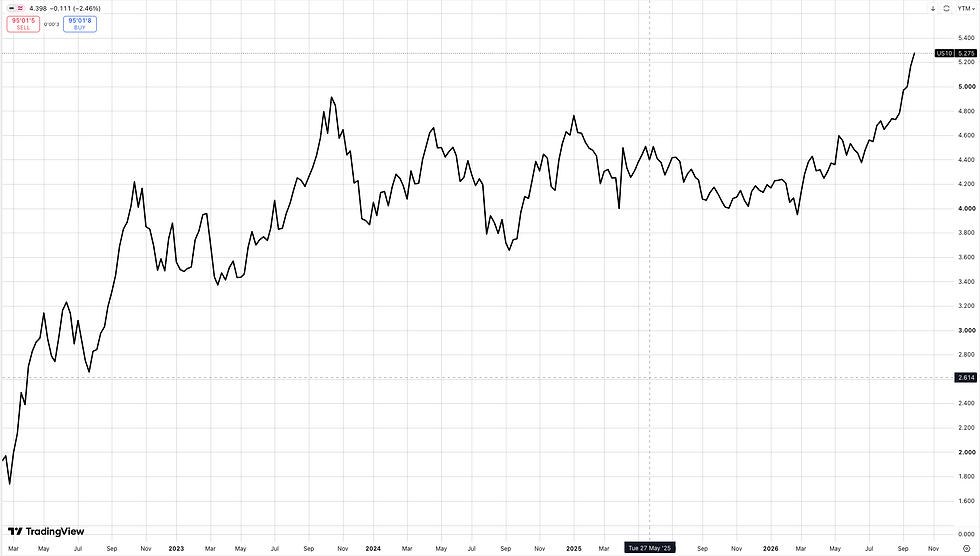
Global equities were constrained by a sharp rise in global yields to multi-decade highs last week. European inflation and credit concerns added to the pressure on global bonds. But yields partly retraced after softer US jobs data and a favourable inflation reading, even as FOMC members continued to signal further rate increases.
Australia raised rates to a fifteen-year high but with a less hawkish tone ahead of some positive signs in domestic CPI inflation. The Australian dollar weakened as rate differentials narrowed.
The week ahead brings Australian confidence and job advertisement figures, US services data and Fed minutes, an election in Brazil, and a rate decision in India.
Global equity indices finished last week little changed, despite considerable price activity beneath the surface. Government bonds initially sold off, with longer-dated US Treasury yields reaching their highest levels since 2002, before softer American inflation and jobs data allowed yields to recover part of the move and carried the Nasdaq Composite to a fresh all-time high.
The Reserve Bank of Australia raised the overnight cash rate to 4.6% on Tuesday, its highest level in fifteen years. The accompanying tone was nonetheless less hawkish. The governor said the Board hoped the four rate rises delivered this year would be enough to return inflation to target.
There were signs that earlier increases were gaining traction. In data released last week, Australian household spending undershot expectations in August, rising +6.8% yoy, down from a surprisingly strong +7.0% in July.
The August headline CPI re-accelerated to +4.0% yoy, though the move was heavily influenced by administrative changes to fuel subsidies. More encouragingly, the trimmed mean measure held steady at +3.6% yoy. Energy challenges remain, not least because China suspended most refined-fuel exports for October last week, covering diesel, petrol and jet fuel. Even so, there are some indications that “home-grown” inflationary pressures may be easing.

Futures markets pared back to pricing just one further cash-rate increase, most likely in mid-2027. The Australian bond index made a small gain over the week, while international fixed income faced stronger headwinds from a combination of inflation and credit concerns. The Australian dollar weakened on the prospect of fewer rate rises compared to the US.
President Trump said the White House was still “very seriously” considering a ban on diesel exports as fuel prices rise ahead of November’s midterm elections. Analysts warned that such a ban could backfire. The move was more likely intended to pressure allies, with the G7 subsequently agreeing to a “substantial release” of diesel stocks.
In the eurozone, the preliminary estimate of September CPI inflation exceeded forecasts, jumping to +3.8% yoy from +3.2% yoy in August. French government bonds were in the spotlight amid mounting deficits and political instability; as a member of the single currency, France has less room to manoeuvre because it cannot print its own currency.
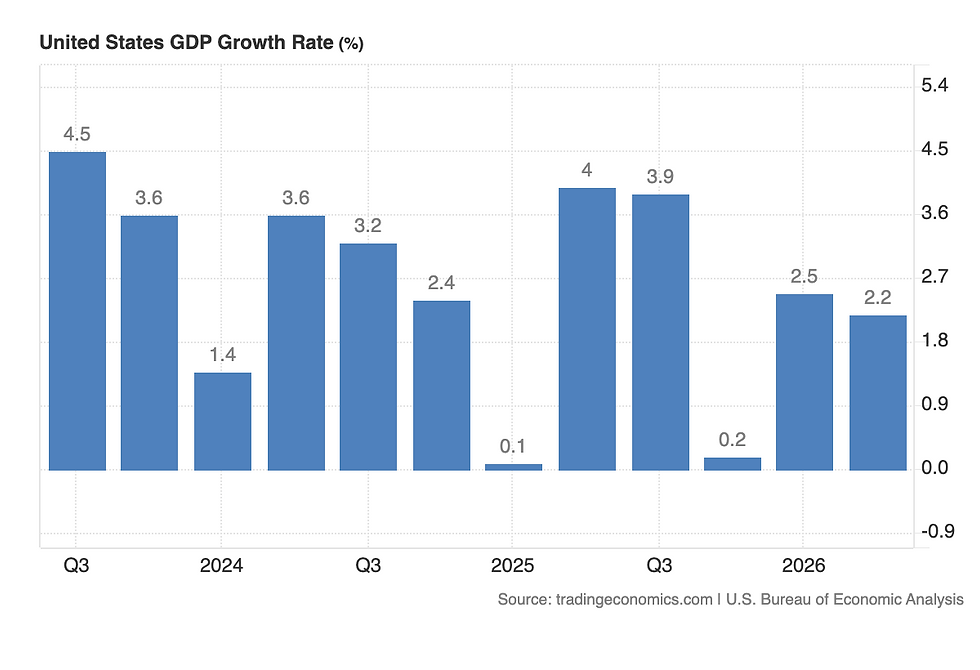
News was more encouraging on the other side of the Atlantic. The Bureau of Economic Analysis revised its estimate of second-quarter US GDP sharply higher, from an annualised +1.5% to +2.2%. Real final sales to private domestic purchasers, the sum of consumer spending and gross private fixed investment, rose at an annualised +4.6%, up +0.4% from the previous estimate and echoing other recent surveys pointing to accelerating activity.
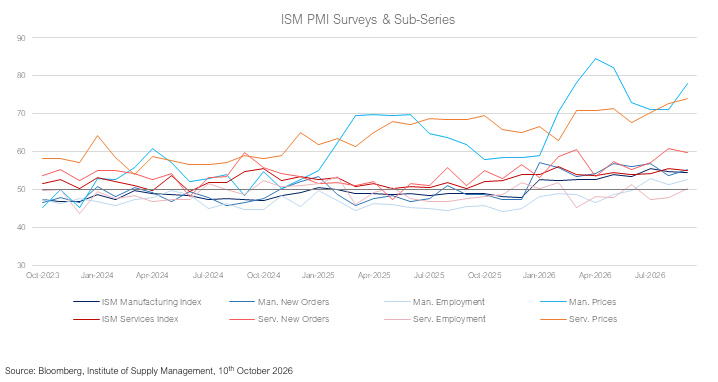
The ISM manufacturing survey showed steady expansion at 54.5, driven by new orders at 55.3. A higher prices-paid reading of 77.9 nonetheless continued to underpin inflation concerns, even as the accompanying PCE inflation report came in better than expected.
The Federal Reserve’s preferred inflation gauge came in below the consensus estimate at +3.4% yoy in August, and the prior month’s reading was revised down to the same level. Core PCE likewise held at a downwardly revised +3.0% yoy.
On Friday, non-farm payrolls added just +29,000 jobs, and with -60,000 of downward revisions to prior months, the figure substantially undershot the +90,000 consensus forecast. These numbers are highly likely to be revised. The Fed may nonetheless take some comfort from the slight rise in unemployment, from 4.1% to 4.2%. The increase was driven by greater labour supply, with the participation rate rising from 61.6% to 61.8%, while a -0.1% fall in underemployment to 7.6% suggested that demand for labour continues to grow.
FOMC speakers retained a hawkish tone in their communications last week, and investors still expect more than three further rate increases, to near 4.75% by the end of next year, with the next move likely in December.
Corporate credit added to the pressure on fixed income. The cost of insuring the credit risk of both Oracle and Paramount spiked in lockstep, to around 90 basis points, after Paramount issued US$52 billion of debt to fund its acquisition of Warner Bros. The market had previously assumed that Larry Ellison, the billionaire who controls both companies, would step in to support Paramount should it become overextended. With much of his wealth tied to Oracle, however, concerns over total leverage and negative free cash flow pushed spreads wider.
Artificial-intelligence safety remained in the news, with corporate leaders gathering at the White House to launch a voluntary AI safety code endorsed by the president.
In China, PMIs were stable. The official composite survey sat close to neutral at 50.7, while the RatingDog private survey edged up from 52.1 to 52.4. Industrial profits slowed to +4.2% yoy, likely due to seasonal factors.
The week ahead brings the minutes of the September FOMC meeting, which should show broad support for further tightening and may also provide an update on the Fed’s balance-sheet review. US activity data are expected to show the services sector expanding at a slower pace, with price pressures likely remaining sticky.
Australian releases include consumer confidence and job advertisements, following today’s NSW public holiday. Brazil holds an election that is too close to call, and the Reserve Bank of India is likely to deliver a hawkish hold. China’s national holiday week continues through to Wednesday.
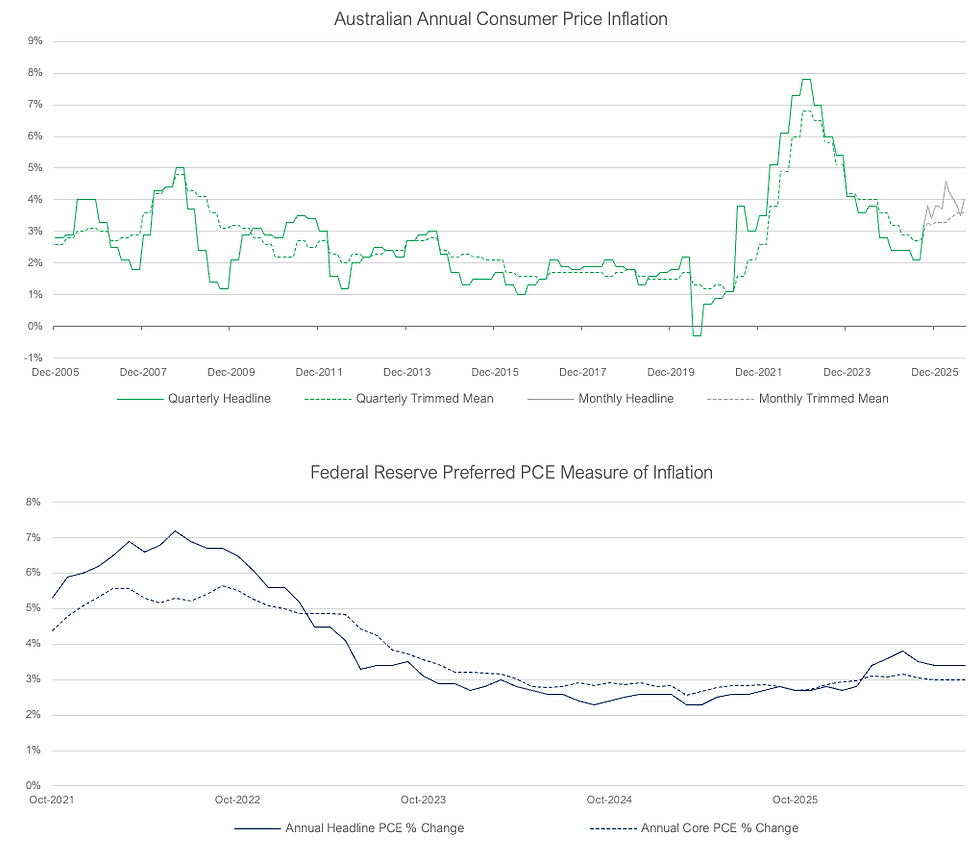

Source: Bloomberg, ABS, BEA, BLS, 3rd October 2026


Source: Bloomberg, S&P Dow Jones, MSCI, FTSE Russell, 3rd October 2026
Disclaimer
The contents of this communication are prepared by Fin-X Capital Group Pty Ltd (A.C.N. 627 650 293; AFSL 520526 trading as Fin-X Capital). The information contained in this communication is general in nature and does not take into consideration any investors personal objectives, goals, needs and financial situation. You should not rely on the information contained in this document to make any investment decisions without first consulting an investment professional such as your financial adviser. Any unauthorised use of this document is prohibited. This document (including any attachments) is intended only for the addressee, it may contain information of a privileged and confidential nature. If you are not the addressee of this communication, you must not copy, reproduce, disseminate or use this email and its contents. If this communication has been received in error by you, please inform us immediately and securely delete. Sharing, transmitting, copying, disseminating all or part of the contents of this document may result in a breach of the Federal Privacy Legislation and or copyright and trademark infringement of Fin-X Capital Group Pty Ltd and its related entities.