Fin-X Weekly 28th September 2026

Global equities hovered near record highs last week, but a sharp rise in bond yields constrained gains.
Conflicts in Ukraine and the Middle East dominated the UN meetings, while US–China talks produced little beyond an extended trade truce.
Strong US survey data pointed to broadening activity growth and renewed price pressures, prompting markets to anticipate further US interest rate rises next year.
Australian unemployment edged higher, though likely not enough to undermine the case for tighter monetary policy. The RBA is likely to raise rates tomorrow.
Australian household spending and inflation data will also be published, alongside US manufacturing and labour market updates, and Chinese profit figures and activity surveys.

Global equities traded around all-time highs last week, with the Nasdaq Composite index reaching a new all-time high on Tuesday. However, a spike in bond yields constrained gains and kept interest-sensitive assets under pressure.

Ongoing conflicts dominated the United Nations meeting in New York. Ukraine’s President Zelenskyy urged countries to intensify pressure on Russia’s export revenues and discussed possible de-escalatory measures with President Trump, including a ceasefire in energy infrastructure. Russia said it remained open to negotiations but would not accept merely pausing the conflict.
President Trump, in turn, defended the US–Israeli campaign against Iran in a fiery speech, warning that Iran could be “annihilated” without a peace agreement. US and Iranian officials nevertheless held indirect discussions on the sidelines, although the US rejected a proposal to reopen the Strait of Hormuz over the weekend.
China’s President Xi did not attend the UN meetings but was received in Washington on an elaborate state visit. Discussions centred on artificial intelligence, which the Chinese agreed to rename “Super Intelligence”, as well as trade, Taiwan and Iran. Little concrete progress appears to have been made beyond an extension of the trade truce, which had been due to end in Novemb
er and has now been extended by two months to January to allow more time for negotiations.
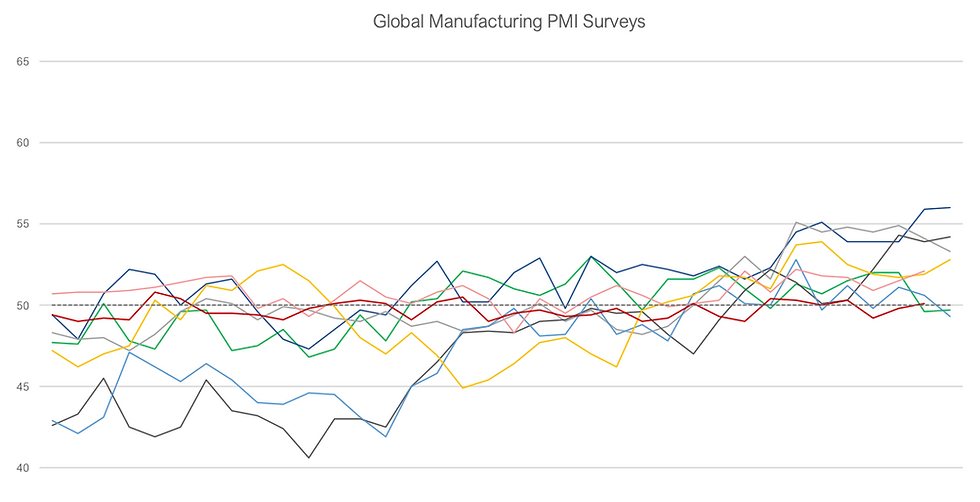
Oil prices remaining above US$ 100 per barrel contributed to a sharp rise in bond yields to multi-year highs, with the 10-year Treasury yield recording its biggest one-day move in nearly 18 months and rising +0.24% over two days. Hawkish statements from Federal Reserve officials and weak demand at a 5-year note auction also added pressure, but a large upside surprise in the US S&P Global flash PMI was likely the main driver.

The composite PMI jumped from 56.0 to 58.4, its highest since July 2021, consistent with annualised growth of roughly +5% in September and +4% in the third quarter. More importantly, strength broadened across services and manufacturing, with domestic demand, new orders, employment and backlogs all accelerating.
The report also showed that the pick-up in activity was producing renewed price pressures due to capacity constraints. Supplier delays increased, firms reported labour shortages, and input-cost inflation reached its highest since October 2022, partly because of higher energy and transport costs.
Chris Williamson, Chief Business Economist at S&P Global, said: “To put the growth surge in context, barring the spike in demand following the opening up of the economy after the COVID-19 lockdowns, the latest improvement in business activity is the greatest recorded since early 2015. Business is clearly booming now in both manufacturing and services.
“However, this growth is being accompanied by some of the most severe supply chain bottlenecks seen in the near-two-decade survey history if the pandemic is excluded, with companies also reporting increasing problems finding suitable staff. Backlogs of work are consequently rising sharply. While this accumulation of uncompleted orders bodes well for the further expansion of output and capacity in the coming months, it also indicates that companies are developing more pricing power, and hence is a worry for the inflation outlook.”
Investors responded by pricing in at least three Federal Reserve rate rises by the end of next year. Neither the ISM surveys nor the BLS labour market report has yet reflected this strength, but both are due for release this week.
Australia’s unemployment rate ticked up from 4.5% to 4.6% in August, the ABS said last week. Seasonally adjusted, +39,000 jobs were added to the economy, but more Australians entered the labour market, lifting the participation rate by 0.2% to 67.1%.
The rise in unemployment is unlikely to prevent the Reserve Bank from raising interest rates tomorrow. In a fireside chat at the Committee for Economic Development of Australia (CEDA), Governor Bullock continued to highlight the upside risks to the inflation outlook, suggesting that an unemployment rate of between 4.5% and 5.0% would probably remove sufficient heat from the labour market to ease inflation pressure. On balance, however, the discussion strengthened the case for tightening, with persistent excess demand, a tight labour market and elevated oil prices outweighing the emerging weakness in housing.

This week’s data are expected to support a rate rise to 4.60%. Household spending, released before the meeting, is expected to accelerate to +7.2% yoy. A day later, headline CPI inflation is expected to rise from +3.5% in July to +4.1% in August.
Beyond the RBA meeting and the US manufacturing and labour market updates, a large amount of European activity and inflation data will be published this week. Chinese industrial profits and PMI surveys will also be released ahead of the national holiday week, which begins on Thursday.


Source: Bloomberg, S&P Global, JPMorgan, CFLP, 28th September 2026


Disclaimer
The contents of this communication are prepared by Fin-X Capital Group Pty Ltd (A.C.N. 627 650 293; AFSL 520526 trading as Fin-X Capital). The information contained in this communication is general in nature and does not take into consideration any investors personal objectives, goals, needs and financial situation. You should not rely on the information contained in this document to make any investment decisions without first consulting an investment professional such as your financial adviser. Any unauthorised use of this document is prohibited. This document (including any attachments) is intended only for the addressee, it may contain information of a privileged and confidential nature. If you are not the addressee of this communication, you must not copy, reproduce, disseminate or use this email and its contents. If this communication has been received in error by you, please inform us immediately and securely delete. Sharing, transmitting, copying, disseminating all or part of the contents of this document may result in a breach of the Federal Privacy Legislation and or copyright and trademark infringement of Fin-X Capital Group Pty Ltd and its related entities.