Rapid Response - US CPI accelerated in May. The bond market expects a hawkish message next week

American May CPI inflation was broadly in line with expectations. But risks of broadening inflationary pressures are becoming more evident. The bond market expects Kevin Warsh to be hawkish at his first press conference as Fed Chair next week.
Headline May CPI released by the BLS last night showed a monthly +0.5% monthly increase in US inflation, down from +0.6% in April and in line with consensus forecasts.
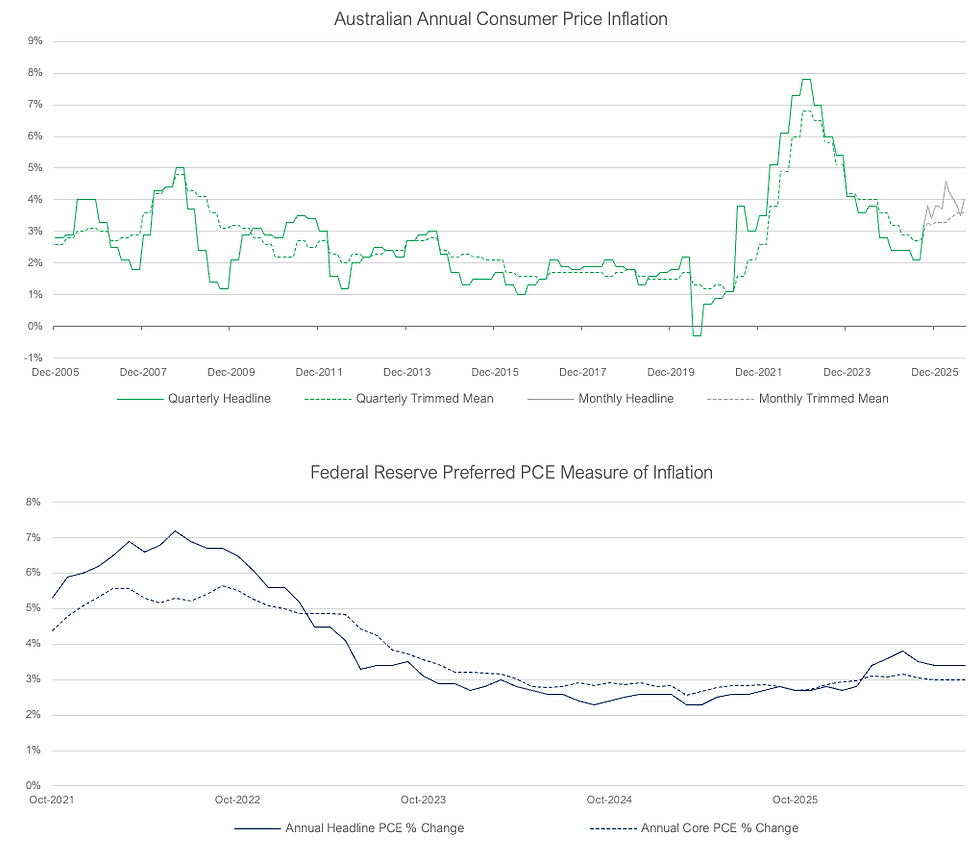
There was, however, a reacceleration in annual price increases to +4.2% yoy, the highest level since April 2023, as weaker readings from May 2025 dropped out of the comparison base. The annual change was nevertheless in line with expectations.
The increase was driven overwhelmingly by energy, which rose by +23.5% over the last year. The index for energy added +3.9% in May, after rising by +3.8% in April.
The gasoline index increased by +7.0% on a seasonally-adjusted basis in May, and +8.6% before seasonal adjustment. The annual increase was +40.5%.
Airline fares rose by +2.7% during the month and +26.7% over the year.
In contrast, the motor vehicle insurance index declined by -1.7% in May after rising +0.1% in April. The index for household furnishings and operations fell by -0.6%, and the index for new vehicles declined by -0.3%.
Food prices increased by +3.1% over the last year.
Core inflation ex-food & energy remained relatively subdued, rising by +0.2% in May, slightly below forecasts, and down from +0.4% in April. The annual increase was +2.9%, in line with forecasts.
Shelter prices also increased in May, rising by +0.3% and by +3.4% over the last year.
The Fed’s Supercore measure of core services less housing rose by +0.3%, and by +3.7% yoy.
Tomorrow's PPI data is expected to reveal much higher increases in prices paid by businesses. Final demand PPI is expected to rise by +6.4% yoy, with core PPI forecast to accelerate to +5.4% yoy.
Released yesterday, Chinese CPI inflation increased by +1.2% yoy, the same as in the year to April and slightly less than expected. However, producer price inflation accelerated from +2.8% yoy to +3.9%.
Chinese transport costs rose by +5.4% vs +4.6% in April, also driven by energy prices.
S&P500 7,267 -1.6%, Nasdaq Comp. 25,170 -2.0%, S&P/ASX200 8,591 -0.9%
US 2yr 4.15% +1bp, US 10yr 4.56% +1bp
US dollar (DXY) index 100.00 +0.1%, AUDUSD 0.7000 (unch), Gold US$/oz 4,067 -0.1%
Fin-X Wealth View
The higher short-term inflation prints are clearly driven by energy prices, but there are also some worrying signs in the details.
Typically, central banks would look through an energy price shock. Providing that it is short-lived, it does not necessarily have to lead to higher inflation expectations and broadening price rises - the major concern for policymakers.
Higher long-term interest rates continue to weigh on the housing market, so shelter prices are providing some cover for the Federal Reserve by keeping core inflation at a lower relative level. However, the super core services series, excluding housing, is rising faster than expected, suggesting that price rises are starting to broaden.
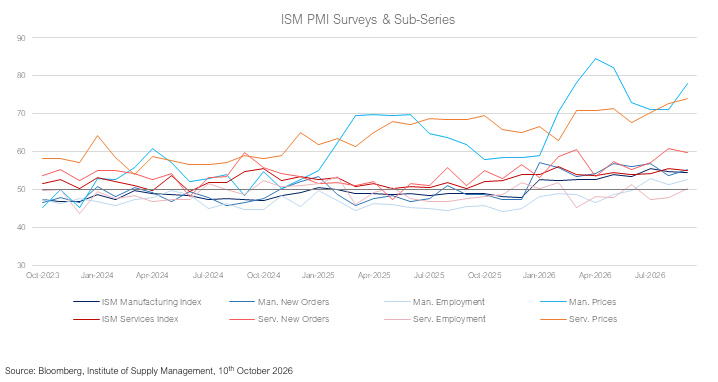
Moreover, the much higher inflation experienced by businesses is likely to squeeze profit margins and encourage them to pass higher costs on to consumers in the coming months. This is a problem in both the US and China, but the context is very different. Faced with exceptionally weak demand, Chinese businesses will find it harder to pass costs on to domestic households but will be incentivised to raise export prices. Consequently, high import prices could place even more pressure on American inflation.
A near-term US interest rate rise remains unlikely. But against a backdrop of intensifying inflationary pressure, the bond market expects Kevin Walsh to deliver a hawkish message at his first press conference as Fed Chair next week, signalling that the next rate move could ultimately be higher. Failing to do so would likely spook bond investors, push long-term yields higher, and be a very negative outcome for the Treasury.
So far, breakeven inflation rates suggest that the Fed will be responsive and that a deflationary bust is still perhaps the most likely outcome. Either higher inflation or a deflationary bust would be negative for equities, but neither is yet being priced in. Combined with the impact of several very large IPOs, we expect higher equity volatility ahead.


Disclaimer
The contents of this communication is prepared by Fin-X Capital Group Pty Ltd (A.C.N. 627 650 293; AFSL 520526). The information contained in this communication is general in nature and does not take into consideration any investors personal objectives, goals, needs and financial situation. You should not rely on the information contained in this document to make any investment decisions without first consulting an investment professional such as your financial adviser. Any unauthorised use of this document is prohibited. This document (including any attachments) is intended only for the addressee, it may contain information of a privileged and confidential nature. If you are not the addressee of this communication, you must not copy, reproduce, disseminate or use this email and its contents. If this communication has been received in error by you, please inform us immediately and securely delete. Sharing, transmitting, copying, disseminating all or part of the contents of this document may result in a breach of the Federal Privacy Legislation and or copyright and trademark infringement of Brerona Capital Asset Management Pty Ltd and its related entities.