Fin-X Weekly Update 10th August 2026

Global equities pushed to fresh record highs, buoyed by strong corporate earnings and inflows. SpaceX published its first quarterly result as a public company.
A weaker-than-expected US labour market prompted investors to pare back expectations of further rate rises, softening the US dollar and lifting gold.
Australian domestic data proved resilient, with household spending surprising to the upside.
The main events this week will be the RBA’s rate decision and updated quarterly forecasts, the NAB business survey, followed by US inflation and retail sales, and UK Q2 GDP numbers.
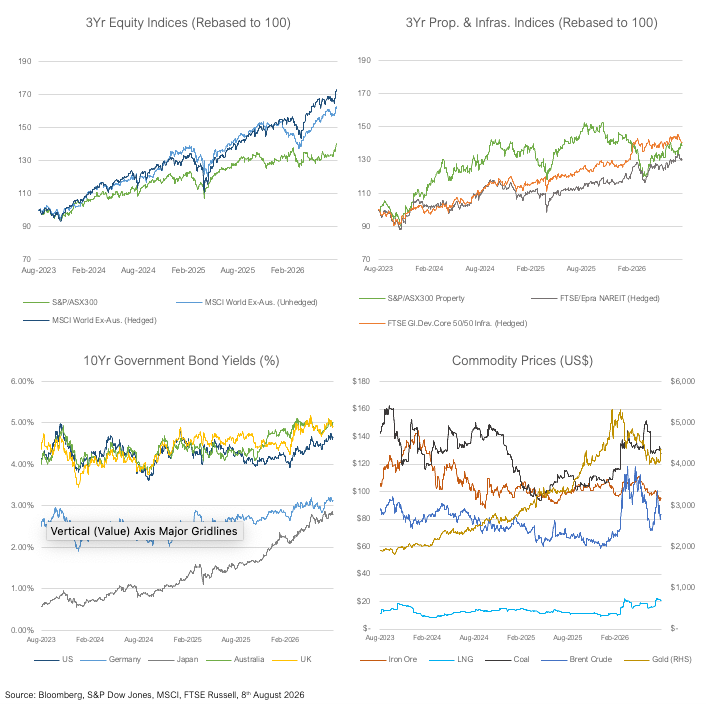
Global equities broke higher last week, with the S&P/ASX300, the S&P500 and the MSCI AC World index all reaching new record highs. Stocks were supported by strong earnings and continued inflows into risk assets, even as long-end government bond yields hovered near levels not seen since 2007, holding the Nasdaq Composite just below its June peak.
Geopolitical risks eased at the start of the week after President Donald Trump called off a major attack on Iran to allow for negotiations. US Treasury Secretary Scott Bessent then further boosted sentiment by telling CNBC that the United States and Iran could reach a deal to open the Strait of Hormuz on Tuesday or Wednesday, saying an agreement would allow commercial ships to move freely through the strait. He raised eyebrows, however, when he later said in a separate interview that the strait would “never” return to its previous status, since the “Iranians are trying to use it as a choke point”. Instead, he suggested it would become “irrelevant”, as roughly 50%–70% of the energy currently transiting the strait would be rerouted through underground pipelines. Analysts cast doubt on that timeline and highlighted that Qatari LNG cannot be rerouted.
The US dollar softened towards multi-week lows following the previous week’s Federal Reserve decision to hold rates despite elevated inflation and coordinated intervention to support the yen. At the same time, gold rallied sharply as investors sought duration and tail-risk hedges.
Expectations of further Fed rate hikes were subsequently pared back after a disappointing Bureau of Labor Statistics jobs report on Friday. Economists had expected +80k new payrolls to be added in July, up from +57k in June, but there was a substantial miss: July payrolls fell by -23k, alongside -103k of revisions to the prior two months. Average hourly earnings also undershot, recording an annual increase of +3.2%, down from +3.5% in June.
Counterintuitively, the unemployment rate dropped from 4.2% to 4.1%, though this reflected a fall in the participation rate. The unadjusted employment-to-population ratio slipped by -0.1% to 58.9%.
More positively, both the ISM manufacturing and services reports showed an increase in new orders, and manufacturers reported an increase in employment. Both surveys remained beset by significantly higher prices paid, however, and employment in services contracted in July, negating some of the more positive signs in the June JOLTS report. Even so, this week’s CPI numbers are expected to show a modest easing in the annual headline and core price increases.
The 2-year Treasury yield closed just below 4.20%, down roughly -0.15% from the 2026 high reached on 23rd July. The yield curve steepened as longer-dated Treasury yields remained closer to their recent peaks.
In Australia, job ads rose +0.8% during July and were up a steady +2.1% on a year ago. Household spending remained comparatively choppy, rising +0.8% in June after a +1.2% gain in May and a -1.0% fall in April, though the +6.0% annual increase was a positive surprise. Tom Lay, ABS head of business statistics, said: “The […] rise in June was driven by discretionary spending rising for the second month in a row […] thanks to continued strength in Transport and Recreation and culture. New Vehicle sales were the standout within Transport this month, driving a +3.0% rise […] Electric vehicle sales increased significantly over the year and have continued that trend in June, accounting for a growing share of overall new vehicles sales as households adjust their spending behaviour in response to rising fuel prices.” The government’s temporary fuel subsidies ended last Monday.
Air travel spending was the second largest contributor to the strength in Transport spending, returning to levels seen before the travel disruptions caused by the Middle East conflict that began in March 2026.
Released over the weekend, Chinese inflation eased, with the annual increase in CPI slipping by more than anticipated from +1.0% yoy in June to +0.5% yoy last month. PPI also fell, from +4.1% yoy to +3.5% yoy, as oil prices eased.
Global energy companies reported soaring profits as a result of the conflict. Overall S&P Global 1200 index earnings were up +52% compared with a year earlier, with 898 of 1,132 companies having reported. The energy sector led the way with a +138% annual increase, compared with +109% for technology names. President Donald Trump said the oil majors had made “too much money” during the conflict: “They’re going to give some of that back to the public and they better cut the retail price, the consumer price.”
Among individual companies, SpaceX reported a +92% increase in annual revenue in its first public results release, with its net loss narrowing to -US$541 million from US$1 billion. The share price initially dipped after capital expenditure jumped sixfold to US$18.4 billion in the second quarter, but more than recovered on Friday to finish +22.8% higher over the week, but still US$2 shy of the US$135 IPO price. Chief Executive Elon Musk said SpaceX would reach US$1 trillion in annual revenue in 2030, versus a previous forecast of 2031, allaying investor fears.
Palantir’s second-quarter earnings saw commercial revenue soar +149% from a year earlier, with the software company attributing the result to firms demanding AI sovereignty. Palantir’s results “further weaken the bear case around rising AI competition”, Citi analysts said, as demand for data privacy from AI companies sets it apart.
Berkshire Hathaway’s cash hoard fell to US$365.5 billion in the second quarter, down from roughly US$397 billion in the prior period, as Chief Executive Greg Abel put more of the firm’s cash pile to work. It spent about US$4.5 billion buying back its own shares and purchased nearly US$20 billion of equities during the quarter. Operating earnings climbed +16% in the three months to June, to nearly US$13 billion, driven in part by gains in the conglomerate’s manufacturing, service and retailing division, as well as at its utilities business.
The positive earnings sentiment also carried over to credit markets, which saw solid inflows and steady spreads despite a high volume of issuance.
In the week ahead, the RBA is almost certain to keep rates on hold tomorrow as it releases its updated quarterly forecasts, while there is only a slim chance of a Norwegian rate rise on Thursday.
The NAB business survey is also due tomorrow, with US retail sales following the inflation figures later in the week. UK GDP figures are due for the second quarter, along with production and inflation figures from several European countries.


Source: Bloomberg, S&P Dow Jones, MSCI, FTSE Russell, 8th August 2026

Disclaimer
The contents of this communication is prepared by Brerona Capital Asset Management Pty Ltd (A.C.N. 627 650 293; AFSL 520526). The information contained in this communication is general in nature and does not take into consideration any investors personal objectives, goals, needs and financial situation. You should not rely on the information contained in this document to make any investment decisions without first consulting an investment professional such as your financial adviser. Any unauthorised use of this document is prohibited. This document (including any attachments) is intended only for the addressee, it may contain information of a privileged and confidential nature. If you are not the addressee of this communication, you must not copy, reproduce, disseminate or use this email and its contents. If this communication has been received in error by you, please inform us immediately and securely delete. Sharing, transmitting, copying, disseminating all or part of the contents of this document may result in a breach of the Federal Privacy Legislation and or copyright and trademark infringement of Brerona Capital Asset Management Pty Ltd and its related entities.