Fin-X Weekly 25th May 2026

Global markets balanced AI-led earnings optimism against rising bond yields, hawkish central bank, communications and weaker growth signals.
Nvidia delivered another strong quarter, but its share price fell as investors focused on China risks. SpaceX officially lodged its IPO papers.
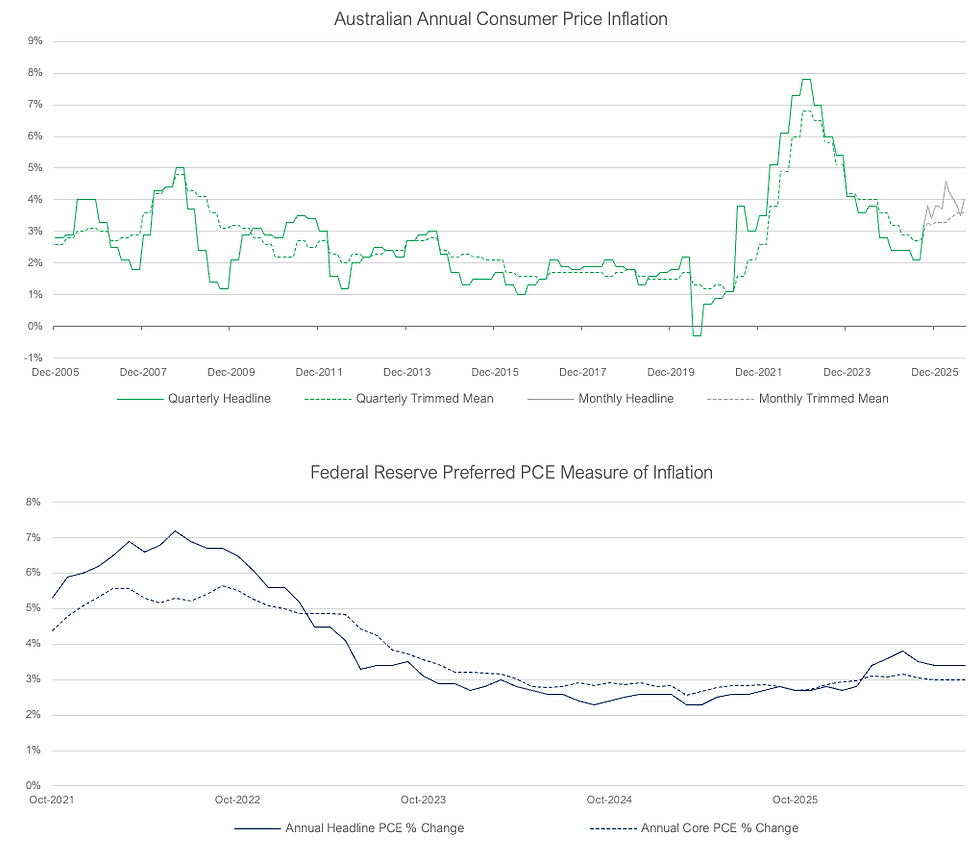
Australian CPI and US PCE inflation are the main data points scheduled this week. But President Trump promised over the weekend that a peace deal with Iran would soon be announced, without providing details. If true, investor sentiment is likely to improve.
Global markets spent the week oscillating between AI-driven earnings optimism and a worsening Iran-driven energy shock. The shock pushed long-end yields to new cycle highs and strengthened the US dollar, even as equities advanced.
US equity indices remained near record highs after earlier gains. Large-cap growth and AI beneficiaries continued to outperform value and small caps, although higher rates capped index-level advances.
Nvidia’s Q1 results were strong across every key metric. Total revenue reached US$81.6 billion, ahead of consensus expectations of approximately US$78.8 billion, up +20.0% on the prior quarter, and +85.0% yoy. Free cash flow reached a record US$50.3 billion for the quarter, up from US$27.4 billion a year earlier, supporting a US$80 billion share buyback. The quarterly dividend was also raised by a factor of 25 to 25c. Nvidia expects revenue of US$91 billion in Q2, but investors sold the stock in a pattern seen over the past four quarters. The share price ended the week down -4.4% after CEO Jensen Huang said the company has “largely conceded” the Chinese AI chip market to Huawei.
Elon Musk’s SpaceX officially filed for its IPO on Wednesday. The company expects to raise approximately US$ 75 billion, implying a total valuation of US$ 1.75 - 2.00 trillion. Derivatives suggest that the company is expected to maintain its value into the IPO, as investors anticipate the stock will be quickly bought by index funds. However, active managers have reservations related to Mr Musk’s degree of control and large operating losses.
US Treasury yields spiked on Tuesday on fears that inflation is reigniting. The 30-year Treasury yield reached 5.18%, its highest level in nearly 19 years. The 10-year yield rose to 4.67% before receding to 4.56% by the end of the week.

The minutes of the latest Federal Reserve meeting also delivered a hawkish surprise. An unusually high number of dissents accompanied the meeting. Dovish dissenter Stephen Miran has been replaced by incoming Chair Kevin Warsh, but several other members called for a more balanced outlook on rates. The minutes revealed that "The vast majority of participants noted an increased risk that inflation would take longer to return to the Committee's 2% target than previously expected […] Almost all participants noted that there was a risk that the conflict in the Middle East could persist for an extended period, or that even after the conflict ended, prices of oil and other commodities could remain elevated for longer than expected […] A majority of participants highlighted that some policy firming would likely become appropriate if inflation were to continually run above the 2% target.”
Australian investors continued to parse the federal budget last week, with the government still struggling to garner support for its capital gains tax reforms outside residential housing.
RBA Assistant Governor (Economic) Sarah Hunter gave a closely watched speech on domestic inflation and the policy outlook. She said policy should not react to a direct energy price shock itself but must respond if that shock flows into broader costs and inflation expectations. She delivered a notably hawkish warning: if inflation expectations become de-anchored, the RBA would need to deliver “a more substantial slowing of economic activity, as we saw during the early 1990s recession” to restore credibility.
Despite the hawkish messages, global activity data deteriorated over the week. Australian unemployment unexpectedly rose from 4.3% to 4.5%. The increase partly reflected a drop in participation and partly reflected fewer roles than usual being added in April, despite an increase in hours worked. The RBA and Treasury had not expected unemployment to reach 4.5% before mid-2027. Australian 10-year government bond yields slipped by -0.15% over the week to close at 4.92% on Friday.
Australia’s S&P Global flash PMI report showed a sharp deterioration. The composite reading fell to 47.8, returning to contraction. Services, at 47.7, drove most of the weakness due to uncertainty around energy costs and higher interest rates. Manufacturing held up better at 50.2, but output contracted for a fourth consecutive month, and employment fell.
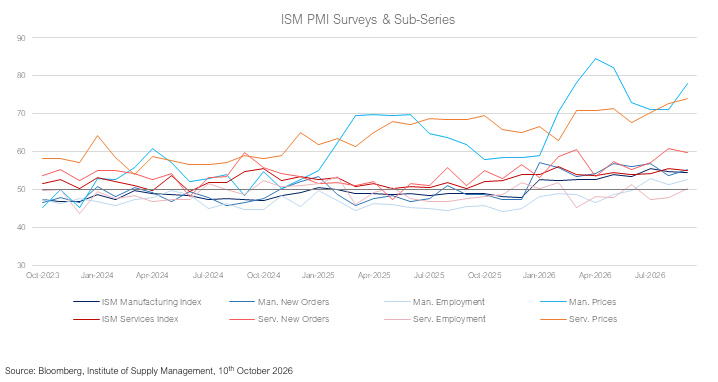
US manufacturing reached 55.3, a four-year high, well ahead of the anticipated 53.8 and up from 54.5 in April. The strength largely reflected war-driven stockpiling of goods amid concerns about further supply chain disruption from the closure of the Strait of Hormuz. Input prices surged to 79.5, the highest level since June 2022, while output prices jumped to their highest level since late 2022 as costs passed through.
The cross-country picture is stagflationary in the short term, while demand is softening and the growth outlook is deteriorating.
Chinese PMIs have yet to be released. But Monday’s April activity data was equally concerning, with substantial misses in both industrial output, at +4.1% yoy, and retail sales, at +0.2% yoy. 2026 fixed asset investment, at -1.6%, also missed expectations and contracted, while the slump in property investment deepened to -13.7% ytd yoy.

More positively, President Trump posted on Saturday that an agreement with Iran has been “largely negotiated” and that details will be announced soon. Any deal with Iran seems likely to trade strict nuclear and regional constraints for sanctions and oil relief, a ceasefire and the reopening of the Strait of Hormuz, probably through a staged memorandum rather than a single grand bargain. Tehran, however, still claims it is likely to retain control of the strait.
In addition to details on the peace deal, the week ahead includes Australian CPI and US PCE inflation for April, expected at +4.4% yoy and +3.8% yoy, respectively. Chinese industrial profits are also due, along with Japanese activity data and European inflation and GDP updates.

Disclaimer
The contents of this communication is prepared by Brerona Capital Asset Management Pty Ltd (A.C.N. 627 650 293; AFSL 520526). The information contained in this communication is general in nature and does not take into consideration any investors personal objectives, goals, needs and financial situation. You should not rely on the information contained in this document to make any investment decisions without first consulting an investment professional such as your financial adviser. Any unauthorised use of this document is prohibited. This document (including any attachments) is intended only for the addressee, it may contain information of a privileged and confidential nature. If you are not the addressee of this communication, you must not copy, reproduce, disseminate or use this email and its contents. If this communication has been received in error by you, please inform us immediately and securely delete. Sharing, transmitting, copying, disseminating all or part of the contents of this document may result in a breach of the Federal Privacy Legislation and or copyright and trademark infringement of Brerona Capital Asset Management Pty Ltd and its related entities.