Fin-X Weekly 18th May 2026

Inflation pressures re-emerged as the dominant market concern last week, pushing bond yields sharply higher. Global equities still finished slightly ahead after new US market highs, while Australian shares lagged as banks and supermarkets weighed on the local index.
The Federal Budget centred on housing tax reform, with limited direct support for household spending and improved deficit projections driven by higher receipts and savings.
President Trump’s visit to Beijing delivered little concrete progress to open the Strait of Hormuz or settle trade differences.
This week’s focus turns to Chinese activity data, Australian consumer confidence and unemployment, and the latest S&P Global flash PMI releases.
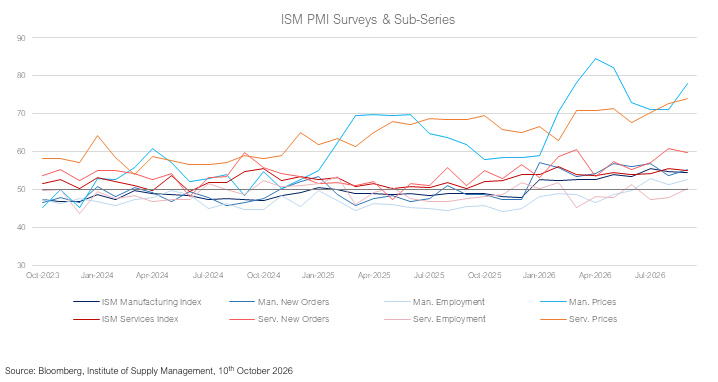
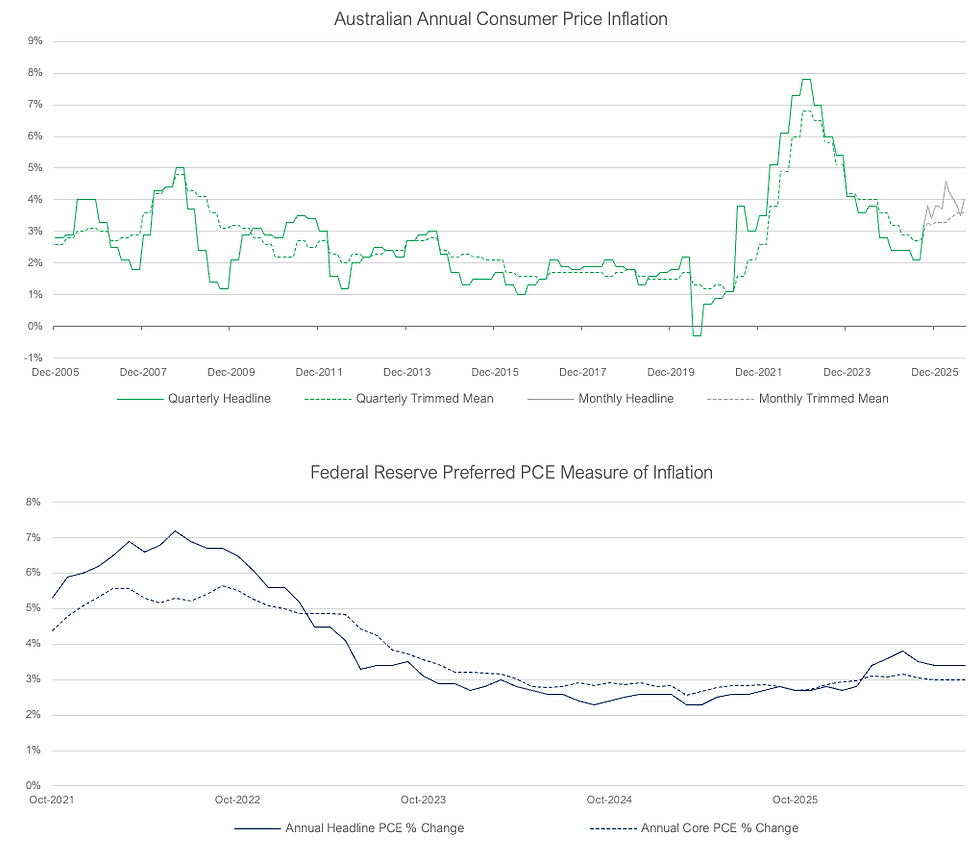
Global markets spent the week repricing for a more entrenched inflation shock, as US and Chinese inflation surprised to the upside, energy prices rose again on stalled Iran ceasefire negotiations, and bond yields climbed sharply, pulling risk assets lower into Friday’s close.
On Monday, China’s April inflation data showed the familiar gap between subdued consumer inflation and a sharp rebound in producer prices. CPI rose +1.2% yoy, signalling still-weak underlying demand despite holiday travel and higher fuel costs. By contrast, PPI rose +2.8% yoy, its strongest annual reading in nearly four years, driven by energy, non-ferrous metals and chemical raw materials. Stronger Chinese producer prices increase the risk that higher goods inflation is exported to other economies.
Tuesday’s US CPI release was firm on the year-on-year measure, even as monthly momentum eased from March’s spike. Headline CPI rose +0.6% mom and +3.8% yoy, up from +3.3% in March. Energy prices rose +3.8% over the month and accounted for more than 40% of the April increase. Core CPI rose +2.8% over the year, up from +2.6% in March and clearly above the Federal Reserve’s 2% target.
Producer prices surprised even more sharply to the upside. The PPI for final demand rose +1.4% mom in April, its largest monthly increase since March 2022, taking the annual rate to +6.0%. Final demand goods prices rose +2.0%, with a +7.8% rise in energy prices driving approximately three-quarters of the increase. Final demand services rose +1.2%, led by wholesale and transportation margins.

The inflation data intensified concerns that the war-driven energy shock is feeding into broader price pressures and triggered a sell-off across global bond markets. The 10yr US Treasury yield rose to 4.6% on Friday, its highest level since May 2025. The 30yr yield rose to 5.1%, its highest closing level since July 2007.
Despite the downbeat end to the week, global equities closed slightly higher after the S&P 500 and Nasdaq Composite reached new all-time highs on Thursday, while Australian shares lagged global peers.
Coles shares fell -3.8% after the Federal Court found that the majority of pricing tickets submitted to the court did not offer genuine discounts and would have misled an ordinary consumer. Woolworths, which will soon defend a similar ACCC action, fell -1.9%.
CBA shares fell -9.4% over the week after a softer-than-expected trading update and concerns that reforms announced in the Federal Budget could affect lending books. NAB fell -4.8%, while Westpac and ANZ each fell -4.3%.
The Budget delivered a major housing‑focused tax package, limiting negative gearing for residential properties to new builds and replacing the 50% CGT discount with inflation‑indexed gains and a 30% minimum CGT rate from 1st July 2027. Despite earlier fears, there were few measures to increase household spending and intensify inflationary demand pressure, save for a new $250 “Working Australians Tax Offset” and a permanent $20k instant asset write‑off for small business.
If passed, the measures are likely to increase pressure on company management to distribute franked income rather than investing for growth and job creation.
The Budget papers also included relatively optimistic estimates from the Treasury. Compared with the 2025–26 MYEFO, the underlying cash balance improves by $44.9b over the forward estimates, leaving deficits at around 1% of GDP but on an improved trajectory, according to Treasury forecasts. The improvement largely reflects higher receipts and net savings of $26.1b.
Near-term macro forecasts included weaker GDP growth and higher inflation due to the conflict in the Middle East. Real GDP growth was reduced to +1.75% in 2026–27 from +2.25%, CPI was lifted to +5.0% to June 2026 before easing to +2.5% in 2026–27, and unemployment is expected to drift up by only +0.2% to 4.5%.
Also on Tuesday, the NAB Business Survey showed a slight improvement in confidence, from -29 last month to -24. Conditions fell to 3, the lowest reading in 11 months.

CBA household spending data showed consumers spent -1.2% less in April, reversing most of March’s fuel-driven +1.6% increase.
President Trump’s visit to Beijing was symbolically important but yielded few concrete outcomes. There were headline economic deals and a new “stability” framing for the relationship, but no breakthroughs to ease geopolitical tensions.
During the summit, Xi Jinping used unusually blunt language to warn that US support for Taiwan could trigger a “very dangerous” or “extremely perilous” situation in US-China relations if mishandled, implicitly cautioning Washington against defending or politically backing Taipei beyond the current status quo.
Iran and the Strait of Hormuz were central to the agenda, reflecting both countries’ exposure to Gulf energy flows. The Americans left without visible commitments from China to materially pressure Tehran or guarantee maritime security.
The president touted large purchase commitments, including agricultural purchases, notably soybeans, and a sizeable order of Boeing aircraft and GE jet engines. But China did not publicly confirm the size or details of these purchases.
US trade rules were essentially unchanged. Additional tariffs implemented in 2025 have driven a sharp fall in Chinese exports to the US, down roughly -20.0% in 2025 and still falling in early 2026. China has offset this with rapid growth in exports to the rest of the world.
In a win for the White House, Kevin Warsh was confirmed as the 17th Chair of the Federal Reserve. Jerome Powell’s term officially ended on Friday, but he will continue to serve pro tempore until Warsh is sworn in, likely this week.

Keir Starmer faces an extremely turbulent week as his position as Prime Minister hangs in the balance after poor local election results and mounting pressure from within the Labour Party. Former Health Secretary Wes Streeting, who resigned from the cabinet and publicly declared his intention to run in any leadership race, reportedly failed to secure the required 81 MP backers needed to trigger an immediate contest. Greater Manchester Mayor Andy Burnham is pursuing a longer route to challenge Starmer by running in a by-election after MP Josh Simons resigned to create a vacancy.
The latest RBA and FOMC minutes will be published this week. Chinese monthly activity figures are due later today, with prime rates due to be updated later in the week. Australian Westpac Consumer Confidence is due tomorrow, while unemployment is expected to remain steady in Thursday’s release. Japanese GDP and CPI figures, the European IFO survey, and the latest flash PMI surveys from S&P Global are also due.
US Earnings Season Remains Strong
Recent US earnings data has continued to surprise positively despite mounting inflation and geopolitical pressures. According to the latest FactSet Earnings Insight report, the S&P 500 is currently tracking Q1 earnings growth of +27.7% year-on-year - the strongest result since Q4 2021. Revenue growth is also running at +11.4%, marking the highest revenue growth rate since Q2 2022.
Importantly, 84% of S&P 500 companies have beaten EPS expectations, while 80% have exceeded revenue forecasts, reflecting continued resilience across corporate America despite rising input costs and higher bond yields.
Technology remains the standout sector, with Information Technology revenue growth running at +29.2% year-on-year, led by continued strength in semiconductors, software and hardware.
For more infromatiom, click here.

Disclaimer
The contents of this communication is prepared by Brerona Capital Asset Management Pty Ltd (A.C.N. 627 650 293; AFSL 520526). The information contained in this communication is general in nature and does not take into consideration any investors personal objectives, goals, needs and financial situation. You should not rely on the information contained in this document to make any investment decisions without first consulting an investment professional such as your financial adviser. Any unauthorised use of this document is prohibited. This document (including any attachments) is intended only for the addressee, it may contain information of a privileged and confidential nature. If you are not the addressee of this communication, you must not copy, reproduce, disseminate or use this email and its contents. If this communication has been received in error by you, please inform us immediately and securely delete. Sharing, transmitting, copying, disseminating all or part of the contents of this document may result in a breach of the Federal Privacy Legislation and or copyright and trademark infringement of Brerona Capital Asset Management Pty Ltd and its related entities.