Fin-X Weekly 27th January 2026

Heightened geopolitical tensions at Davos shaped global markets before President Trump softened rhetoric around Greenland, easing pressure on risk assets.
US growth indicators pointed to slowing momentum while Japan’s proposed fiscal expansion unsettled global bond markets. China met its annual growth target, albeit with softening consumer demand.
In Australia, unemployment was lower than anticipated, leaving markets pricing an above-even chance of a rate rise next week, ahead of this week’s expected acceleration in CPI inflation.
Other events this week include the FOMC and Riksbank meetings, a heavy US earnings calendar, and GDP releases across Europe.
Global equities sold off early last week as volatility rose, before recovering after President Trump appeared to moderate his rhetoric around a potential takeover of Greenland at what proved to be one of the most consequential World Economic Forum (WEF) meetings in years.
Bond markets were volatile following the announcement of a planned fiscal expansion in Japan, while the Australian dollar strengthened after a firm headline unemployment result.
Precious metals continued to attract demand, with gold rising above US$5,000 per ounce for the first time yesterday.
In his speech last week, the American president said Greenland was a necessary component of his plan for a “golden dome”, modelled on Israel’s Iron Dome missile defence system. Ahead of his arrival at the WEF, European leaders had already described the president’s Greenland ambitions as unacceptable and paused plans to ratify the 2025 trade deal following renewed tariff threats. The unthinkable prospect of one NATO member attempting to seize another's territory raised existential questions about the alliance. However, the most striking speech at Davos was delivered by the Canadian prime minister, a former governor of both the Bank of Canada and the Bank of England.
In his address, Prime Minister Mark Carney said, “Let me be direct: we are in the midst of a rupture, not a transition”. He described the previous rules-based order as a polite fiction and argued that middle powers needed to work together while diversifying alliances and partnerships. He added, “First, it means naming reality. Stop invoking the rules-based international order as though it still functions as advertised. Call it what it is: a system of intensifying great power rivalry where the most powerful pursue their interests using economic integration as coercion.”
Reinforcing the point over the weekend, President Trump threatened to impose 100% tariffs on Canadian imports should the announced trade pact between Canada and China proceed.
Domestically, the president appeared to encounter resistance to his agenda after the Supreme Court signalled scepticism about his authority to remove Federal Reserve Governor Lisa Cook. Trump appointee Brett Kavanaugh warned that the administration’s position would “weaken if not shatter the independence” of the central bank.
President Trump has yet to confirm who will replace Jerome Powell as Chairman when his term ends in May. BlackRock’s Rick Rieder has moved to the top of prediction market odds following supportive comments from the president last week. The president has consistently favoured aggressive monetary easing. Even so, the FOMC is almost sure to keep rates unchanged at 3.75% this week, with just -0.5% of easing priced by the end of next year.
In the real economy, and ahead of a cold change expected to weigh on activity this week, pending sales of US existing homes fell in December by the most significant margin since April 2020. The -9.3% decline was broad-based across regions, suggesting emerging stress in the housing sector. The president continues to push plans for US$200 billion in mortgage-backed security repurchases and a 10% cap on credit card interest rates for one year.
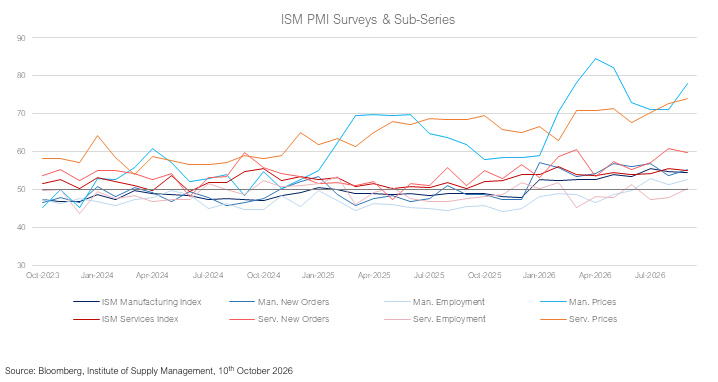
According to Chris Williamson, Chief Business Economist at S&P Global, the US flash PMI survey pointed to “annualised GDP growth of +1.5% for both December and January, and a worryingly subdued rate of new business growth across both manufacturing and services adds further to signs that first quarter growth could disappoint.” He added that “jobs growth is meanwhile already disappointing, with near stagnant payroll numbers reported again in January, as businesses worry about taking on more staff in an environment of uncertainty, weak demand and high costs.” Williamson also noted that “increased costs, widely blamed on tariffs, are again cited as a key driver of higher prices for both goods and services in January, meaning inflation and affordability remains a widespread concern among businesses.”
In Europe, modest expansion continued across the Eurozone, though activity remained subdued in France. Germany’s ZEW survey rose to its highest level since 2021, indicating improving confidence in the outlook.
Japanese firms reported their fastest growth in more than a year, with momentum accelerating since December and manufacturing returning to expansion.
Against this backdrop, the Japanese government has sought to capitalise on recent popularity by calling a snap election for 8th February. However, bond investors reacted negatively to newly appointed Prime Minister Sanae Takaichi’s proposed fiscal expansion. Long-dated Japanese yields rose to fresh highs, with spillovers into global bond markets. The US 30-year yield jumped +0.1% to 4.9% before easing back to 4.8% yesterday.

In China, official data showed GDP growth of +4.5% yoy in the December quarter, slowing from +4.8% in Q3. Full-year growth was reported at +5.0%, meeting the government’s target of around 5%. Industrial production rose +5.2% yoy in December, exceeding expectations for a +5.0% increase. However, retail sales growth slowed from +1.3% yoy in November to +0.9% in December, marking the weakest pace since late 2022.
Turning to Australia, the OECD warned last week that national debt will rise sharply without budget repair or tax reform. The organisation called for higher levies on fuel and property, a broader consumption tax base, and spending restraint to stabilise public finances.
ABS data showed that Australian unemployment fell from 4.3% in November to 4.1% in December on a seasonally adjusted basis. This was below the consensus forecast of 4.3% and the RBA’s most recent projection of 4.4%. The figures appear to overstate labour market strength relative to trend measures, which showed unemployment at 4.2%. Employment continued to grow in 2025, though the +1.1% pace of job growth remains well below the +1.9% expansion in the working-age population.
Jingyi Pan, Economics Associate Director at S&P Global, said that “January’s S&P Global Flash Australia PMI indicated that business activity growth accelerated in the opening month of the year, reflecting resilient economic conditions at the start of 2026. Growth has also become more balanced with solid expansions observed in both the manufacturing and service sectors.”
“Forward-looking indicators offered conflicting signals, however, as faster new order growth contrasted with falling business optimism, especially among services firms. While the reduction in business confidence was largely underpinned by recent geopolitical developments, the trend will be worth monitoring in the months ahead.”
She added, “Overall output price inflation softened at the start of the first quarter of the year, attributed to easing service sector charge inflation while manufacturing selling price inflation remained stable. However, rising manufacturing input prices represent risks for inflation to intensify again in the coming months.”
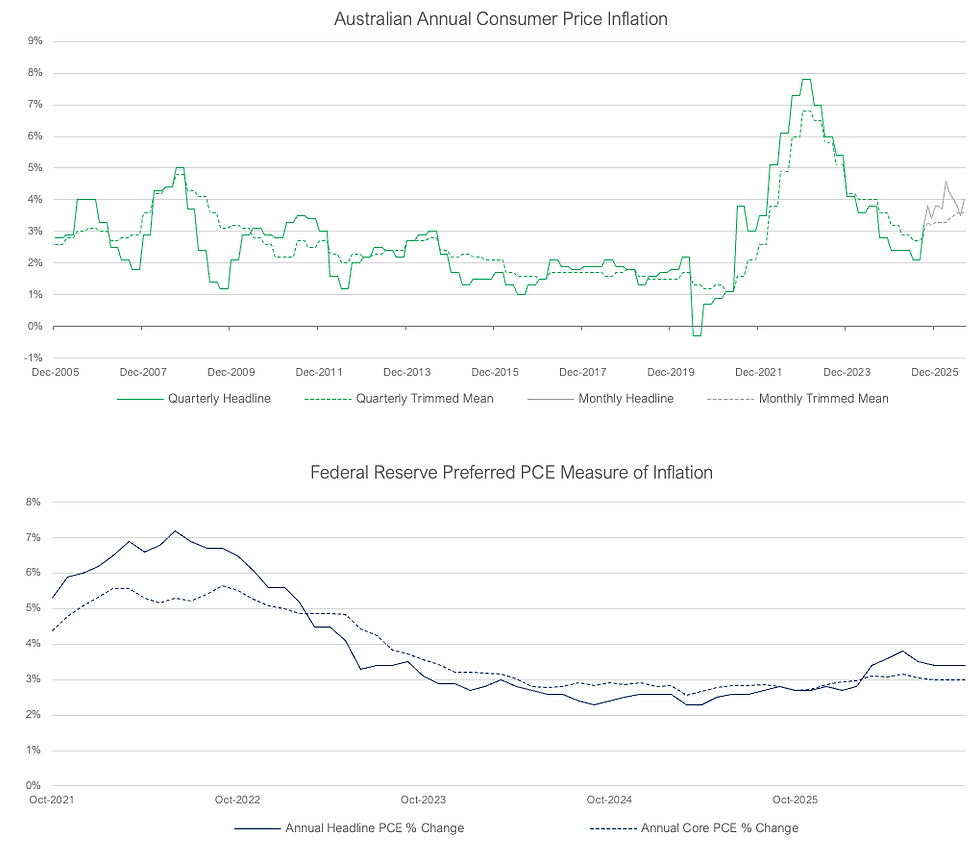
The NAB monthly business survey is due later today, followed by Australian CPI figures tomorrow. Headline inflation is expected to accelerate to +3.6% yoy in December with core inflation forecast at +3.2% yoy, both remaining above the RBA’s 2%–3% target band. Markets are pricing a 60% probability of a +0.25% rate increase to 3.85% next week, with two hikes in total still expected this year.
While Davos and macroeconomic developments dominated headlines, corporate earnings season continued. Bloomberg data show that around 81% of the 63 S&P 500 companies reporting so far have exceeded expectations, with aggregate earnings up around +18% from a year earlier. TSMC delivered stronger-than-expected results alongside bullish capital expenditure guidance, supporting the AI and semiconductor theme. Intel also reported better-than-expected results in the December quarter, driven by data centre and AI demand, but unsettled markets with weak guidance and margin pressures. Netflix posted solid growth supported by advertising momentum, though it flagged slower growth in 2026 and higher content spending.
A further 102 S&P 500 companies are scheduled to report this week, including Microsoft, Apple, Meta, Tesla, ASML, Boeing, Blackstone, Comcast, Visa and Mastercard.
Besides the Federal Reserve, the Swedish Riksbank is also expected to leave policy settings unchanged.
Beyond Wednesday’s Australian CPI release, producer price data are due in both Australia and the US on Friday. The Eurozone and several EU member states will also publish fourth-quarter GDP figures at the end of the week.


Disclaimer
The contents of this communication is prepared by Brerona Capital Asset Management Pty Ltd (A.C.N. 627 650 293; AFSL 520526). The information contained in this communication is general in nature and does not take into consideration any investors personal objectives, goals, needs and financial situation. You should not rely on the information contained in this document to make any investment decisions without first consulting an investment professional such as your financial adviser. Any unauthorised use of this document is prohibited. This document (including any attachments) is intended only for the addressee, it may contain information of a privileged and confidential nature. If you are not the addressee of this communication, you must not copy, reproduce, disseminate or use this email and its contents. If this communication has been received in error by you, please inform us immediately and securely delete. Sharing, transmitting, copying, disseminating all or part of the contents of this document may result in a breach of the Federal Privacy Legislation and or copyright and trademark infringement of Brerona Capital Asset Management Pty Ltd and its related entities.